Project dates: 2011 to 2016
The threat of climate change has provoked action on a global scale. New deals and funding mechanisms have been set up, with the aim of reducing emissions. One consequence of this is the growth of a market in carbon.
This project examined the power, politics and perceptions of carbon in Africa as new schemes are planned and put into action. It ran from 2011 to 2016.
Book
Carbon Conflicts and Forest Landscapes in Africa
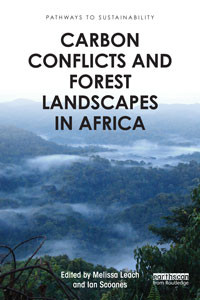 Carbon Conflicts and Forest Landscapes in Africa examines how carbon forestry projects are unfolding, their effects, and who is gaining and losing. The book’s case studies cover a wide range of African ecologies, project types and national political-economic contexts.
The book is edited by Ian Scoones and Melissa Leach and is available from Routledge.
Download the Accepted Manuscript of Chapter 1 (pdf, Open Access)
Order this book from the publishers (20% discount: use code DC361)
Other publications
- Carbon forestry in agricultural landscapes: ready for the competition?
- Governing REDD+: global framings versus practical evidence from the Kasigau Corridor REDD+ Project, Kenya
- Forest Carbon Projects in Africa: A Mapping Study
- Carbon Offsets and Agricultural Livelihoods: Lessons Learned From a Carbon Credit Project in The Transition Zone Of Ghana
- The Politics of Agricultural Carbon Finance: The Case of the Kenya Agricultural Carbon Project
A growing market
Carbon trading and offset schemes have led to a massive growth in projects, consultancies, companies and advisory groups aiming to capture the new value of carbon. In Africa, this raises important questions about land governance, local politics and the people who depend on and live on the land.
Most research on this topic is about how to get projects to work more effectively. Our research looks beyond this operational focus, and examines the politics of carbon in Africa in historical context, looking back at longer-term changes.
What assumptions, interests and politics are behind the various mechanisms and policy schemes, such as UN-REDD? How do people think, justify and argue about particular projects? Who wins and loses from the commoditisation of carbon and how does it shape land, livelihoods and ecologies? What does it mean for justice?
Cases
- Forests in Kenya: a UN-REDD project begun in 2006, expected to conserve over 500,000 acres of forest in the Kasigau Corridor.
- Western Kenya: a project working with a registered farmers’ association in Western Kenya, supporting agroforestry, residue management and increasing soil carbon.
- Ghana: a scheme in southern Ghana providing land, tree seedlings, equipment and carbon credits to farmers and others to engage in “tree farming”.
- Sierra Leone: a project to develop a REDD scheme around a long-established forest reserve in the country’s Western Area
- Zambia: a number of schemes, including agroforestry/conservation in farming areas; private sector initiatives in conservation areas; and projects aiming to “modernise” traditional forest fallows in farming. Zambia is one of the first UN-REDD pilot countries.
Media coverage
- 12 July 2012: Appropriating nature? China Dialogue – Putting a value on nature once seemed at the forefront of progressive thinking, but in an interview with the Transnational Institute, Melissa Leach argues that it has instead turned into a wave of land grabbing.
- 20 June 2012: Q. and A.: The Dark Side to ‘Green’ Transactions, New York Times – STEPS director Melissa Leach is interviewed by Joanna M Foster for the New York Times about the appropriation of nature in the name of ‘green’ market initiatives.
- 20 June 2012: The dark side of the green economy: ‘Green grabbing’ by Melissa Leach, Al Jazeera – Melissa Leach blogs for Al Jazeera about fostering an agenda focused on distribution, equity and justice in green market arrangements.
- 13 June 2012 Environmental goals affect local population (pdf) – translation, Jonathan Witteman, De Volkskrant
- 13 June 2012 Milieudoel treft lokale bevolking (pdf) – original article in Dutch, Jonathan Witteman, De Volkskrant
STEPS members working on this project:
- Melissa Leach – Co-convenor
- Ian Scoones – Co-convenor
Project partners:
- Ishmael Hashmiu, IITA, Accra, Ghana
- Tom Winnebah, Njala University, Sierra Leone
- Joanes Atela, NEPAD, Kenya and University of Leeds
- Martin Kijazi, University of Toronto / Tanzania
- Guni Mikels-Kokwe and Misael Kokwe, independent researchers, Zambia